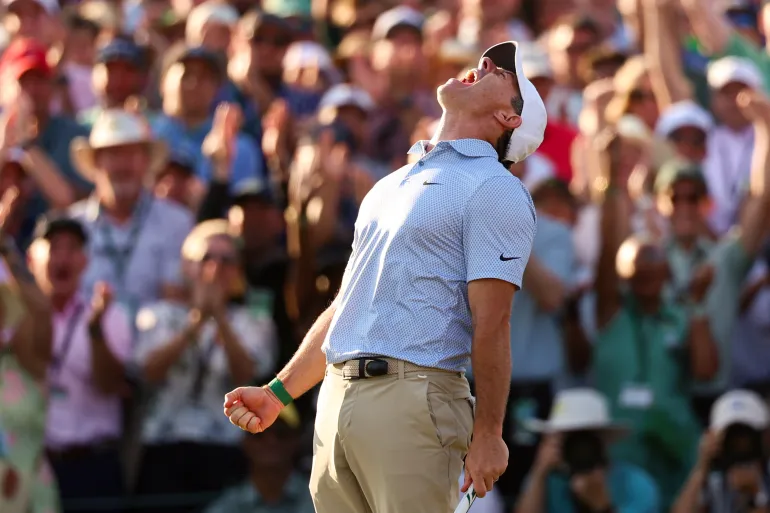

History was made once again at Augusta National as Rory McIlroy secured his second consecutive Masters title, confirming his place among the game’s all-time greats. In a tournament filled with momentum swings and pressure moments, McIlroy held his nerve to edge out Scottie Scheffler by a single stroke and claim another Green Jacket.
The victory was far from straightforward. McIlroy started the tournament in dominant fashion, opening with rounds of 67 and 65 to reach 12-under-par and build a record-breaking six-shot lead at the halfway stage.
At that point, it looked like a procession. But Augusta rarely allows anything to come easily.
A third-round 73 brought the chasing pack back into contention, with Cameron Young drawing level heading into the final round. Suddenly, what had seemed like a comfortable march to victory turned into a test of resilience.
Sunday delivered exactly that.
McIlroy found himself under real pressure early in the final round, briefly losing ground as mistakes crept into his front nine. But champions respond, and McIlroy did just that. A series of crucial birdies, particularly through Augusta’s iconic Amen Corner, shifted momentum back in his favour at the perfect time.

From there, it became a battle of composure.
Scheffler applied relentless pressure down the stretch, but McIlroy held firm. Standing on the 18th tee with a narrow lead, he knew a bogey would likely be enough. Even after finding trouble off the tee, he recovered brilliantly, navigating the closing hole to secure victory by a single shot.
It was a performance defined not by dominance, but by control under pressure.
With this win, McIlroy joins an exclusive group of players to have won back-to-back Masters titles, alongside legends such as Jack Nicklaus, Nick Faldo, and Tiger Woods.
Beyond the history, the victory also highlights a key evolution in McIlroy’s game. Long known for his power and ball striking, it was his mental resilience and course management that ultimately made the difference. After seeing a commanding lead disappear, he regrouped, recalibrated, and delivered when it mattered most.
This was not just another major — it was a statement.
McIlroy’s sixth major championship further strengthens his legacy and reinforces his dominance in the modern game. At 36, he is no longer chasing validation; he is building a body of work that places him firmly among golf’s elite.
The bigger question now is not whether McIlroy can win again at Augusta, but how many more he might add.
Because based on this performance, the journey is far from over.
 My Goat Sports