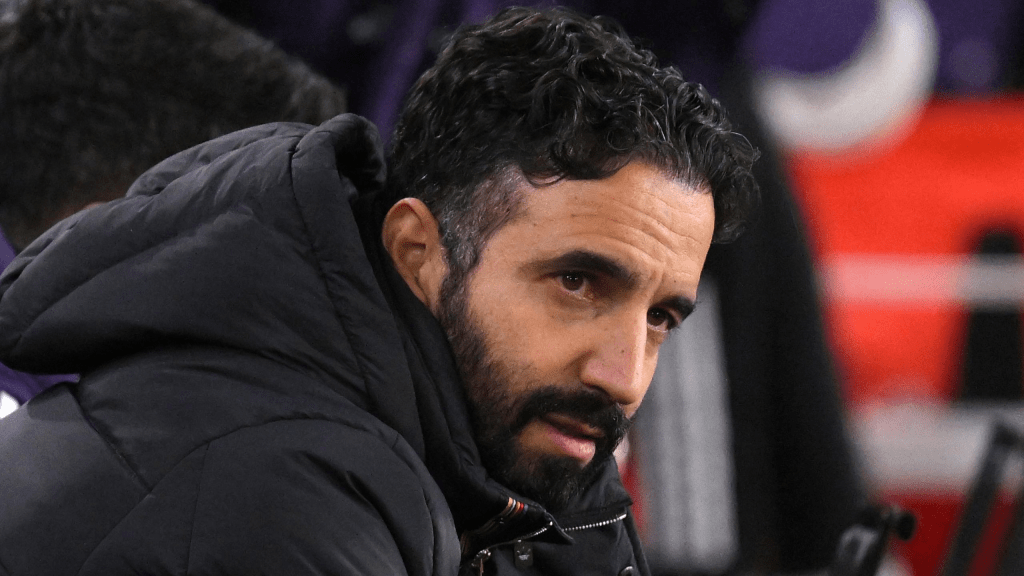

Ruben Amorim cut a surprisingly relaxed figure as he emerged from his Cheshire home on Monday afternoon, just hours after being sacked as Manchester United head coach. Accompanied by his wife, Maria Joao Diogo, the Portuguese coach was seen smiling broadly, a stark contrast to the tense and defiant persona he displayed only a day earlier at Elland Road.
Amorim’s dismissal came with immediate effect following Sunday’s draw against Leeds, a match that was overshadowed by his outspoken post-match comments and an increasingly strained relationship with the club’s hierarchy. While his public rant appeared to be the final straw, it has since emerged that United’s leadership had already made the decision to part ways with him two days before the trip to Yorkshire.
The 40-year-old was summoned to Carrington on Monday morning, where he was informed of the decision in a meeting with director of football Jason Wilcox and chief executive Omar Berrada. The call was made with the full backing of the board and Sir Jim Ratcliffe, signalling a decisive move by United’s new leadership structure under Ineos.
Behind the scenes, tensions had been building for weeks. A key meeting between Amorim and Wilcox took place after a disappointing 1-1 draw with bottom-placed Wolves, during which Amorim reverted to his favoured back-three system. United’s hierarchy reportedly made it clear they believed the squad — strengthened by £250 million of summer signings — was capable of playing more progressive, attacking football. Amorim’s furious response to that assessment only deepened the divide.
That fracture was laid bare in his defiant comments after the Leeds match, where he insisted he was hired to be the “manager” of Manchester United, not merely a coach. He spoke openly about authority, structure, and criticism, suggesting fundamental differences in vision between himself and the club’s leadership. Within 24 hours, his fate was sealed.
Amorim leaves Old Trafford after 14 turbulent months in charge, a spell that included United’s worst season in more than 50 years and a rare absence from European competition. Although he did guide the club to a Europa League final in Bilbao, consistency proved elusive, and United currently sit sixth in the Premier League.
His tenure was often marked by scrutiny and ridicule, most notably after footage circulated of him using coaching magnets in the dugout during a Carabao Cup defeat to Grimsby Town. Despite arriving from Sporting Lisbon in November 2024 with a reputation as one of Europe’s brightest young coaches, his ideas never fully took root in Manchester.

United confirmed his departure in a brief statement, thanking Amorim for his service and wishing him well for the future. Former midfielder and current Under-18s coach Darren Fletcher has been installed as caretaker manager and will take charge for Wednesday’s trip to Burnley, as well as the upcoming FA Cup clash against Brighton.
Fletcher’s appointment is seen as a short-term solution. United are reluctant to rush into a permanent appointment, particularly with high-profile candidates such as Thomas Tuchel and Carlo Ancelotti unavailable until after the World Cup. Throwing a new manager straight into a Manchester derby is also viewed as an unnecessary risk.
Despite concerns that the squad was built around Amorim’s preferred 3-4-2-1 system, insiders insist the group is flexible enough to adapt under new leadership. United’s decision-makers believe the change gives the team the best chance of securing European qualification this season.
Attention has already turned to who might lead United into the 2026–27 campaign, with Enzo Maresca emerging as the early favourite, followed by names such as Oliver Glasner, Xavi, Gareth Southgate and Cesc Fabregas. Long-shot options range from Zinedine Zidane to club legends Roy Keane and Gary Neville.
For Amorim, the chapter ends with a substantial compensation package still to be finalised and his reputation bruised but not broken. For Manchester United, the reset button has once again been pressed, as the club continues its search for stability, identity, and a manager who fits their evolving vision of modern football.
 My Goat Sports