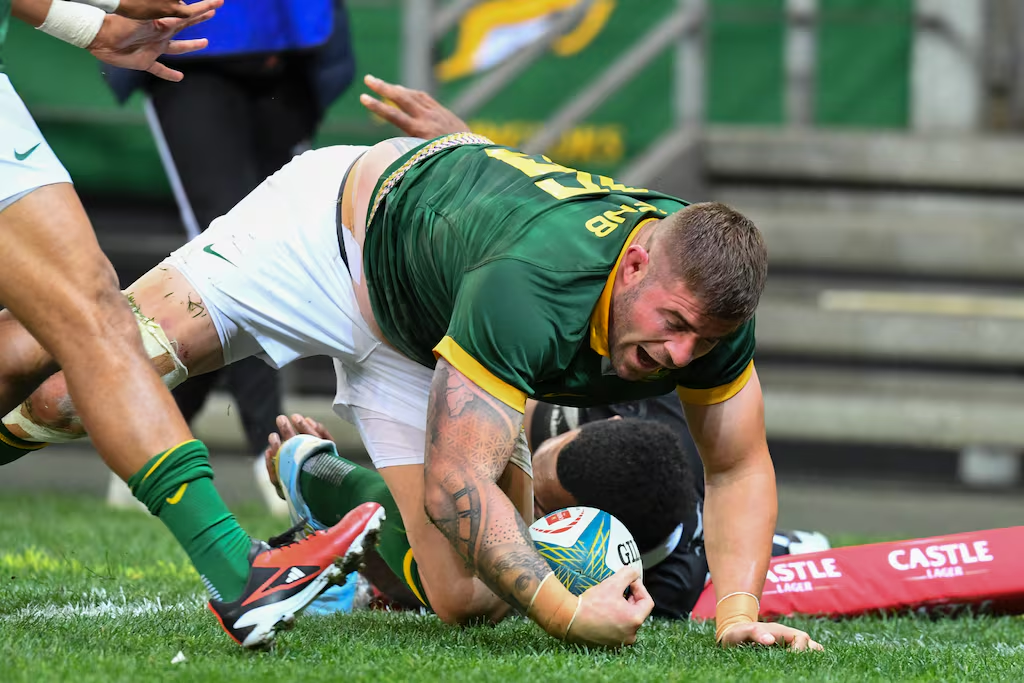

In a fiercely contested Rugby Championship match, the Springboks came from behind to defeat New Zealand 18-12 in Cape Town, securing their fourth consecutive victory over their arch-rivals and reclaiming the Freedom Cup for the first time since 2009. Here are the five key takeaways from the dramatic encounter.
1. Springboks’ Bench Power Shines Once Again
South Africa’s victory was yet another demonstration of the incredible depth they possess. The impact from the bench was pivotal, with Sacha Feinberg-Mngomezulu, Kwagga Smith, and try-scorer Malcolm Marx all making “thundering” contributions in the second half. Marx’s powerful burst over the line and Feinberg-Mngomezulu’s long exit kick were key moments that turned the game in the Springboks’ favor.
Captain Siya Kolisi, playing with renewed vigor since the distractions around his Racing 92 contract ended, also led by example, crashing over from short range to secure the crucial try. The Springboks’ ability to maintain their intensity throughout the match, aided by their bench, proved decisive as they weathered New Zealand’s early pressure.
2. New Zealand’s Costly ‘Coach-Killing’ Two Minutes
The match swung dramatically in the 70th minute with the scores at 13-12 to South Africa. Damian McKenzie had a golden opportunity to edge the All Blacks ahead with a relatively easy shot at goal but hooked it wide. From the ensuing Springbok exit, New Zealand failed to cover the backfield, leading to a penalty and yellow card for Tyrel Lomax after he obstructed Cheslin Kolbe’s run.
What followed was a series of compounding errors, as TJ Perenara abandoned his defensive role, leaving Marx a clear path to the try line. This two-minute meltdown encapsulated the All Blacks’ ongoing struggles in crucial moments, a recurring theme throughout the 2024 Rugby Championship.
3. Tactical Evolution from the Springboks
South Africa’s decision to repeatedly turn down shots at goal, despite having the ever-reliable Handre Pollard on the field, showcased a new level of ambition and tactical evolution. The Springboks backed their attacking systems, prioritizing territorial dominance and physical pressure over point-scoring opportunities.
The first half was scrappy, largely due to slow ball distribution from Grant Williams, which allowed New Zealand’s defense to reorganize. However, the second half saw a shift in tempo, with quicker service from the base of the ruck and sharper exits, enabling the Springboks to stretch the All Blacks and control possession more effectively.
4. New Zealand’s Breakdown Dominance
Despite the loss, the All Blacks showed marked improvement in breakdown intensity, with Codie Taylor and Sam Cane leading the charge. New Zealand’s breakdown work disrupted the Springboks’ flow, generating 11 turnovers and stifling South Africa’s attacking momentum.
Taylor was particularly outstanding, making 11 carries for 71 meters, while young lock Wallace Sititi impressed with 17 powerful runs in only his fourth Test match. However, their dominance in the breakdown was not enough to overcome their tactical and defensive lapses, particularly in the second half.
5. Bongi Mbonambi’s Line-Out Woes
Bongi Mbonambi’s impressive run of faultless line-out throwing came to an abrupt end in this match, with four of his first five throws stolen by the All Blacks. New Zealand’s line-out defense was exceptional, with their locks and jumpers reading Mbonambi’s calls perfectly.
However, the Springboks adapted, relying on their dominant maul and improved scrum performance to regain control of the game. Ruan Nortje, despite some early line-out struggles, delivered a towering performance, making crucial tackles and carries that helped the Springboks maintain their physical edge.
Conclusion
The Springboks’ 18-12 win over the All Blacks reinforced their standing as the team to beat in 2024, with their unmatched bench depth and evolving tactics making them formidable ahead of the Rugby World Cup. For New Zealand, their inability to close out matches under pressure continues to be a worrying trend, and they will need to address their tactical errors if they hope to regain their dominance on the global stage.
As South Africa celebrated reclaiming the Freedom Cup in this significant year, marking 30 years since the dissolution of apartheid, the victory carried extra weight for the Springboks and their fans.
 My Goat Sports