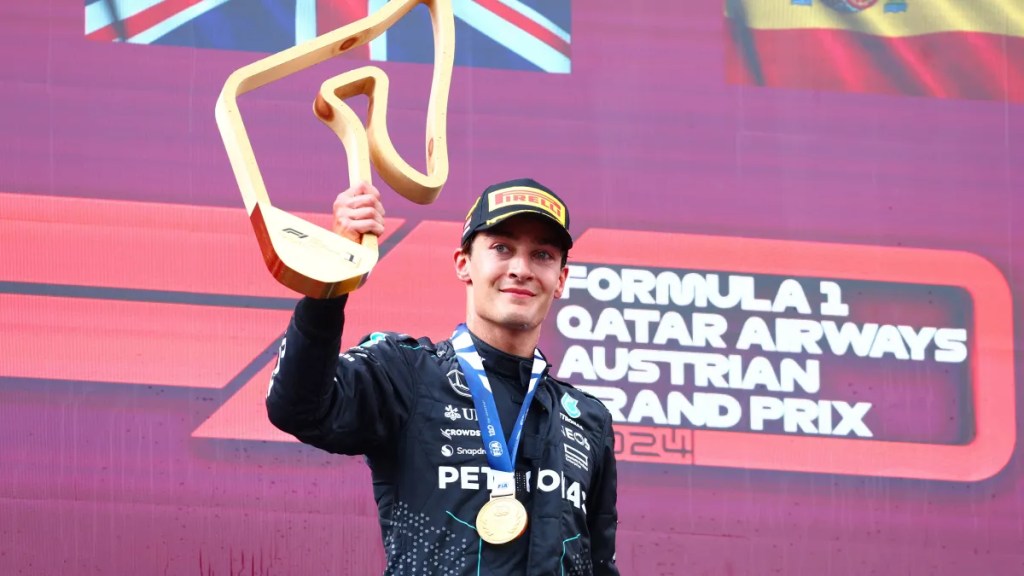

George Russell’s second grand prix victory was a landmark achievement, both personally and for the Mercedes Formula 1 team. Yet, there was a deeper significance to his Austrian Grand Prix weekend that could be crucial in dispelling doubts about his ability to establish himself as the team’s leader.
This significance can be encapsulated in one word: execution.
Russell used this term to describe how he and Mercedes maximized their potential in both qualifying sessions and races in Austria. The Race concurs, awarding the 26-year-old top spot in its driver rankings for the weekend.
Extracting the maximum has not always been a certainty for Russell, who has often left results on the table due to errors and inconsistency. The most recent example was last month’s Canadian GP, a race he had the opportunity to win but for several off-track moments. In Austria, however, there wasn’t so much as a hint of a significant error.
“Without doubt,” said Russell when asked after the race if this was his and the team’s strongest weekend in terms of all-around execution. “We really executed everything really well. Every session we maximized, qualified as high as we think was truly possible, race starts have been good, P4 in the [sprint] race yesterday was the maximum. P3 realistically was the maximum and the deserving result today. The team did a great job. So it’s nice when you get a reward for all that hard work.”
Execution is crucial because it encompasses so much of a grand prix driver’s job and leads directly to results. It’s all well and good having vast ability and grand ambitions, but it’s by consistently deploying your skills, in every way, in terms of preparation and what you do behind the wheel that you are judged.
The Austrian GP weekend was among Russell’s best work in Formula 1. It wasn’t the win itself that proved that; it was the fact he was rock-solid both in outperforming his teammate and putting the Mercedes at its ceiling in terms of results – fourth in both parts of the sprint, then third on the grid for the grand prix, and on course for third before being handed victory.
There are two reasons why this is potentially significant. Firstly, Russell has been battling the balancing act all drivers who emerge as F1 frontrunners must finesse. There’s a fine line between being at the limit and over-reaching, and there have been times where Russell has slipped the wrong side of that line. Canada was one example, as was last year’s Singapore Grand Prix when he hit the wall on the last lap while chasing Lando Norris for second.
Secondly, the weekend also proves that Russell now has a car that will make it far easier to judge that fine line. The Mercedes has been an erratic car throughout most of Russell’s two-and-a-half seasons in F1’s frontline, and it’s difficult to disentangle the extent to which it’s the driver or the car that’s causing the problems.
It’s always a bit of both, but in a car that is now more consistent, even if still far from perfect, as Lewis Hamilton’s struggles prove, Russell was on the money. “We had a car previously that if you got it in the window, it only took a change of wind direction or track temp and suddenly the thing didn’t balance,” says Mercedes trackside engineering director Andrew Shovlin. “That was why we would look good maybe on a Friday, and then suddenly we’re struggling on Saturday. With the changes that we’ve made, the car inherently behaves a bit more normally. The drivers aren’t complaining about oversteer in one area, understeer in another.”

By tackling those erratic characteristics and eliminating the wild swings of balance, Russell will feel on more firm ground. That should make it easier to judge the difference between being at 99-100% or overstepping and hitting trouble.
Russell has always been seriously quick, and his record against Hamilton is hugely impressive. Yes, Hamilton has been battling the same car problems, but Russell has proved beyond any doubt he is fast enough to emerge as the long-term Mercedes leader. What he needs to do is further refine that speed and continue to improve aspects of his game such as tyre management, where his teammate excels.
But while Hamilton is a useful benchmark right now, the fact he’s off to Ferrari casts him as yesterday’s man at Mercedes. The looming threats Russell is really facing are Max Verstappen, should he end up somehow joining Mercedes in the next couple of years, and anointed wunderkind Kimi Antonelli, who is in contention to replace Hamilton. They are very different propositions as rivals, but if Russell is to fulfill what has long been his destiny of winning world championships for Mercedes, he must produce Austrian Grand Prix weekend level performances consistently.
With Mercedes now on the right trajectory, it’s time for Russell to take the final step to bridge the gap that separates the very good from the truly outstanding. Austria might prove to be the launchpad for that – and that’s nothing whatsoever to do with the fact that he won.
 My Goat Sports